






|
|
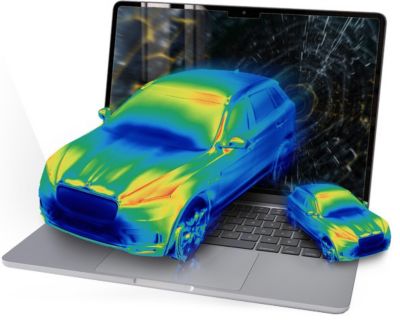
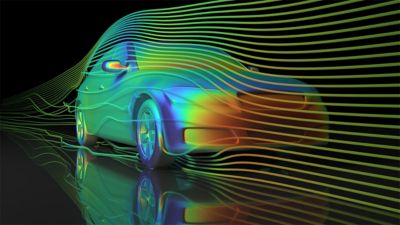
The prediction of external aerodynamics has been one of the most challenging automotive CFD applications. Complex shapes and physics require sophisticated geometry and meshing tools, physical models, substantial computer resources and the right methodology. Fluent staff have focused on this challenge and developed a methodology that produces wind tunnel verifiable results. "The expertise we have developed is an outgrowth of our overall corporate commitment to developing industry and application specialists among our technical staff." MeshingError minimization is the key to high-quality results, and a viscous-hybrid mesh is the most cost-effective way to minimize errors. A good viscous-hybrid mesh starts with a triangular surface mesh that faithfully resolves all important features of the geometry and satisfies the requirements of the physical models and the solver. The goal is to produce, as closely as possible, an equilateral surface triangulation with prudent rates of variation in the nodal spacing. Next, prism layers are extruded from the surface triangles. Using TGrid 3.1, boundary-adjacent prisms are extruded according to a specified value of aspect-ratio, and subsequent layers increase in height at a specified rate. Finally, a tetrahedral mesh is created to efficiently fill the remaining volume. Turbulence ModelingThe Reynolds Stress turbulence Model (RSM) has proven to be effective when an accurate prediction of flow separation on the body is necessary for the success of the simulation. Also effective are non-equilibrium wall functions, which are sensitized to the local pressure gradient. They can partially compensate for relatively high values of surface y+. Minimizing Numerical ErrorsRelative to second-order convective differences, first-order differences increase artificial diffusion and can damp or "diffuse" the solution. First-order convective differences are useful at the start of a calculation because they increase numerical stability when the initialized flow field is a poor approximation to the converged result. Afterwards, second-order differences should be employed so that the physically realistic gradients emerge. Adequate spatial resolution is another requirement for error minimization. Spatial resolution is improved through solution-adaptive mesh refinement. A small series of strategic adaptions usually is sufficient to yield wind tunnel accuracy with only a modest increase in cell count and total CPU-time. Putting it All TogetherWhile the basic building blocks of a successful methodology can be summarized as above, Fluent staff have expended considerable effort to define and refine what constitutes best-practice for automotive external aerodynamics. "The expertise we have developed in-house is an out-growth of our overall corporate commitment to developing industry and application specialists among our technical staff," notes Rick Sam, Director of Fluent's US Automotive Business Unit. ![]() |
FluentNEWS |
||