



“Dr. Ice” and his Skeleton Crew
By David Curtis, Sports Engineering Research Group (SERG), Sheffield University, Sheffield, UK
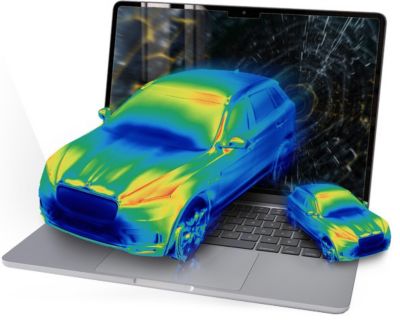
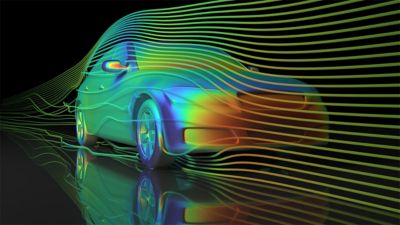
Pressure contours on a simulated skeleton slider, with pathlines colored by velocity magnitude |
The United Kindom is not renowned for its climate being conducive to winter sports. However, with the Winter Olympics in Turin, Italy coming up in February 2006, a new breed of athlete has come along. Kristan Bromley, the top-ranked skeleton bobsled competitor in the UK, and current European Champion, is a leading British medal prospect. He was also the first British male to win a winter sports world cup series when he dominated the 2003/2004 season. Bromley is perhaps unique in the sport because he has a Ph.D. in ice sports technology, and saw the value of CFD in his previous job with the defense company BAE. His passion for skeleton grew while working on a BAE-sponsored skeleton sled project, and it has led him to dedicate himself to becoming the next Olympic champion. Indeed his gold medal quest is tightly coupled to his passion for engineering. He and his brother Richard, who is also his coach, have set up a pioneering technology company to support his ice sports dream and coordinate his UK Sport-funded performance program for the Olympics. Members of the press in the UK have been fascinated by this unique athlete, and have taken to calling him "Dr. Ice" because of his sporting, technological, and academic achievements.
In 2003, Bromley approached the Elite Sports CFD Unit - a part of the Sports Engineering Research Group (SERG) in Sheffield, UK - and asked them to provide CFD flow simulation support to increase his chances of success. SERG has had considerable success in the past with the British Olympic Cycling team in Athens during 2004. Bromley maintains philosophy of using advanced technology to enhance on-ice performance, "We look to our strengths in R&D to help bridge the gap we have with the stronger winter sports nations, so that I can compete on equal terms."His belief that elite-level athletes also require elite-level support led him to collaborate with SERG and make use of Fluent's CFD software, since both have a proven record of success in elite sport.

Dr. John Hart and his colleagues in the Elite Sports CFD Unit began by laser scanning a full-size flexible mannequin on a skeleton sled, They then used specialist surfacing software to produce a high-quality CAD surface on top of the scanned data. This pre-pared the model for import into GAMBIT to create the required volume mesh. A computational mesh suitable for CFD analysis was then constructed using combination of GAMBIT and TGrid. A typical skeleton sled and mannequin mesh consisted of approximately seven million tetrahedral and prismatic elements. The prisms were required over the entire surface of the modeled geometry to accurately capture the surface boundary layers and flow se pa-rations. FLUENT's CFD solver captured turbulent flow effects by using the realizable k-ε turbulence model in conjunction with non-equilibrium wall functions to accurately resolve the boundary layer flows.
The initial area of CFD interest for Bromley has beenskin friction characteristics associated with the customized skin-suit in which he competes. He wanted to assess small changes in surface texture in terms of their impact on minimizing his overall aerodynamic drag. The ultimate proof of the CFD work will come in Turin when all of Bromley's hard work, his mental and physical conditioning, and the technologies behind his sled will be put to the test over the few short minutes of the Olympic competition.
more.info: www.ice-sport-tech.com