





fluent.com home page

    Contact Us
 

A Herculean Task: Keeping Cool at the Athens Olympics


By Mario Miana, José-Ramón Valdés and José-Carlos Peña, Area of Mechanical Engineering, Instituto Tecnológico de Aragón, Zaragoza, Spain

View the pdf of this article

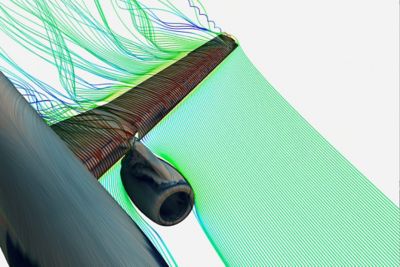
View the flowfield predicted by the independent fan model image
The flowfield predicted by the independent fan model

The sculpture "Nations' Wall," situated at the Olympic Sports Complex in Athens and designed by the Spanish architect Santiago Calatrava, is a monumental structure 260 meters long. It is formed by an assembly of 960 beams which move in a synchronized manner, creating a sinusoidal wave that moves along the monument. This structure was built during the first half of 2004 in record time by the Spanish company Ingemetal, with the technical support of the Instituto Tecnológico de Aragón (ITA).

View the fan orientation in which all variators are cooled image
Pathlines illustrating the flow for one orientation of the fan in which the cooling air reaches all of the variators

The motion of the 960 beams was accomplished by means of 480 electric motors connected to frequency variators. The variators were sensitive to high temperatures, so it was important to keep them working at temperatures below 55-60°C (130-140°F). The high temperatures of the Athenian summer, along with the heat dissipated by the motors, made the use of a cooling system necessary. This system was composed of 120 fans (one fan for each set of four motors), located inside the motor housing.

View the fan orientation in which variators on left are not cooled image
Pathlines for another orientation of the cooling fan in which the variators at left are not sufficiently cooled

At ITA, CFD was used to analyze the fluid flow and heat transfer for different possible fan locations, with the aim of selecting the configuration that provided the lowest temperatures on the variators in the most unfavorable conditions. A sector of the motor housing containing four motors was considered. Computational models were built in GAMBIT, and simulations were carried out in FLUENT. Each model consisted of the housing walls, motors, variators, and fan, and had about 850,000 cells. The standard k-e model was used for the turbulent flow, and periodic boundary conditions were applied to the side walls, due to the repeating nature of the geometry and flow field. On the rest of the domain boundaries, the outer ambient temperature, corresponding to a hot summer day, was set. A constant heat flux was imposed on the walls of the motors to simulate the heat released. The motors also included an internal fan, which was simulated with the 1-D fan model in FLUENT, in which the pressure jump is calculated from the fan characteristic flow rate values. Where appropriate, wall thicknesses were created in the model and wall conduction was simulated as well. An atmospheric pressure outlet was imposed on the slots made for the crank axles that connect the motors with the beams. The air was modeled as an incompressible ideal gas with thermal properties depending on the temperature.

View the temperature contours on the frequency variators image
Temperature contours on the frequency variators; the hot spot on the variator at left was within the thermal tolerance for the unit

The cooling fan was simulated by means of an independent model with a detailed blade geometry. The MRF model with a sufficient mesh density was used to simulate the rotation of the blades. The resulting velocity profiles were extracted from the independent fan model and imposed on the main model by means of a velocity inlet, which simulated the fan outflow into the sector. This approach was a straightforward process for evaluating different fan positions, orientations, and the inclusion of deflectors in order to get the maximum possible cooling. To select the best configuration, the temperature contours and average values on the variators were monitored. Path lines were analyzed in order to understand the flow patterns inside the fan housing and locate recirculation and stagnation zones.

Although there were no experimental results available for validation (as is usually the case in many industrial simulations), the CFD models provided a reliable means for comparing the different configurations and selecting the one that predicted the best cooling performance. Thanks to the CFD simulations, the tight deadlines of the project could be met, even though there was no time for real testing. The configuration selected by means of the CFD models was installed in the structure, and worked without any problems during the Olympic Games.


Previous Article FluentNEWS Next Article