




|
By Keith Hanna from Fluent News recently spoke with Anthony Baxendale,
Aerodynamics Department Manager at MIRA Ltd. in the UK, about the trends
and challenges facing the automotive industry’s use of CFD in the future.
KH: Briefly, what is the history of MIRA, and what does it uniquely bring
to the automotive industry?

MIRAs Anthony Baxendale
AB: MIRA was formed in 1945 as an
independent non-profit organization,
dedicated to carrying out
research and testing for the British
motor industry. Over the years
MIRAs extensive testing facilities
and research have helped
us to gain an in-depth expertise
of individual automotive components,
vehicle systems, as well
as cars as a whole.
We are based in Nuneaton in the
center of England, and a wide range of knowledge built on
our heritage still exists today in our £31million business, which
employs 550 people at several locations.
In the late 1990s, computer simulation technology advanced
to the point where we began to witness a decline in the demand
for some of our existing test facilities. This led us to rethink
our corporate strategy and resulted in a re-focusing of our
research strategy onto new product development. As a result,
MIRA now provides integrated automotive capabilities in a
design-led environment rather than a testing-led
one.
In fact, our strategy continues to evolve in this direction and
we are now positioning ourselves to be the center of excellence
for zero prototype engineering. Already, many projects
we take on now involve the creation of cross-functional
teams of specialists so that we can provide complete solutions
to clients on a project-by-project basis. The management
of such projects presents a real challenge and, as a result,
our culture has had to change.
KH: How has this design-led philosophy versus a testingled
approach affected your aerodynamics group at MIRA?
AB: Eight years ago we only had two CFD engineers in the team,
whereas today we have seven supported by twenty design
engineers, plus a team of five other people working at our
35 m2 full scale wind tunnel. In fact, the term CFD engineer
can be misleading because they are skilled in project
management and experimental techniques as well as CFD.
On balance, the majority of the projects we take on are for
UK clients, although a rapidly growing proportion now comes
to us from the rest of the world. Central Europe and China
are growing markets for our CFD services. Broadly, we find
about 35% of our projects are in the powertrain and underhood
area, 20% involve climate control, and the remainder
involve external aerodynamics or various other topics. An increasing
proportion of our CFD projects are part of larger design
programs. This has meant we have had to break down barriers
between departments and combine our skills. This plays
to our strengths because few of our competitors can begin
to match MIRAs breadth of expertise.
KH: What software does your CFD group use and what CFD
design process have you devised?
AB: We use a wide range of CFD products, including FLUENT, PowerFLOW,
and STAR-CD, plus a number of CAD and grid generation packages including
CATIA, IDEAS Masterseries, ICEM, and Unigraphics. We also use a number
of 1D modeling codes like GT-Power and Flowmaster, which are essential
for us to provide complete automotive solutions to clients when coupled
with other simulation codes and with our physical testing facilities.
In essence, we have most of the products that our clients (collectively)
use, and for these clients, CFD is usually only part of the overall solution
that we provide.

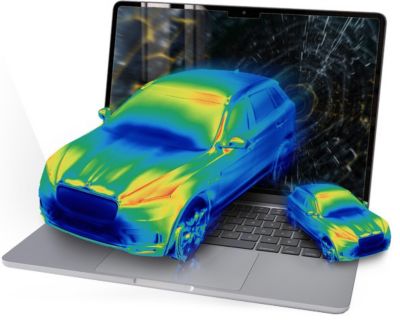
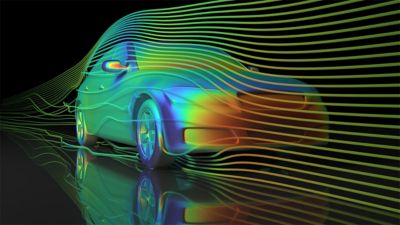
Pathlines over a Mazda MX5
Geometry obtained via www.viewpoint.com
Like many users of CFD in the automotive industry we use
CAD geometries that are either given to us or that we create
ourselves. Indeed, dirty CAD geometries and their cleanup
can take between 10 and 60% of a projects total time.
Hence, we find it helps to educate our CAD engineers on what
makes for good geometry requirements from a CFD perspective.
Basically, they must work on a design with CFD in mind, although
this has to be balanced with the need to design with manufacturing
in mind. This is a significant paradigm shift that
needs to happen for CFD users and the CFD industry as well.
Although we use commercial software, we are developing
some pretty clever processes to cut meshing times and to
integrate solution methodologies. We see this as innovation
and as part of increasing our competitive advantage. For example,
this is happening in the areas of thermal management
and unsteady aerodynamics. We will be promoting our new
capabilities in these and other areas very soon.
A strong part of our CFD process is employing the latest project
management systems and scheduling software to complete
projects on time and on budget. Historically, we have
used large UNIX workstations for our CFD processing, but
lately we have shifted towards PCs because of their reduced
cost per processor, their expanding power, and the ability
to network clusters of them together. Indeed, Fluents software
has the best parallel portability to PC clusters we have
seen (on both LINUX and Windows operating systems).
As we looked at our CFD process over the last few years to evaluate savings
and cost reductions, we identified the need to consolidate our software
and hardware to work with key suppliers like Fluent to develop long term
relationships to our mutual benefit. Today our typical CFD simulations
range between 5 and 15 million cells, although we expect this to rise
to over 25 million in the next year.

KH: FLUENT is a relative newcomer to the group of CFD codes used at
MIRA. What factors led to your recent investment in this software?
AB: We chose the FLUENT CFD software as it offers a wide range of functionality,
is easy to use, and is robust. Another factor in our decision
was that the FLUENT code is requested by many of our major clients,
primarily those in the automotive industry.
KH: Five years from now, where do you foresee CFD being positioned
within the automotive industry?
AB: Three or four years ago we saw a sudden mushrooming of the use of
CFD in the automotive industry as it moved out of the research and
development departments and into the design process. I see a continued
rapid growth in the use of CFD, although there are some significant
process barriers to overcome. In five years time or less, I can
easily see full vehicle CFD models with underhood, climate control,
and external aerodynamics all in one model, developed in a day and
run in an hour! Indeed, I foresee that other simulations will be coupled
to the CFD models and computed concurrently. Almost certainly,
time-dependent simulations will become more routine, and I expect
to see large strides in CFDs integration into the overall design
process.
There will be steady improvements in software accuracy and usability,
and the use of web-based CFD will be more common both within
a company and across sites worldwide.
KH: Finally, what do you see as the challenges for the CFD industry in
meeting the needs of the automotive community in the long term?
AB: For a start, integrating CFD into the design process will be critical
as
part of digital vehicle prototyping. Companies like Jaguar
think in
these terms and have digital gateways in the automotive product
development cycle within a common simulation environment. I believe
that such an environment will join together best-in-class
software
products with expert systems software and common data management
structures. We need to develop organizational learning skills as
we go along so we can manage risk and fill gaps in our knowledge
and processes quickly.
Another big area for the future is what we call co-simulation
where,
for example, in the field of aero-acoustics, automotive CFD aerodynamics
departments will predict noise levels for a given automotive
design. This data will then be fed into a Structures Code to see how
the noise interacts with the vehicles body. Ergonomics software
will
be used to register how this noise will be perceived inside the car. There
will, therefore, be a need for the right links between different software
technologies such as these.
In terms of CFD advances, I can easily foresee a growth in demand
for large-eddy simulation (LES) modeling in CFD, and improved turbulence
models for more accurate predictions. This is naturally so because
all real-world flows are inherently unsteady anyway. In the future, the
best hardware and CFD software on the market will have to meet these
automotive market demands.
It is my belief that at the end of the day, CFD engineers will use the
best available tools from a toolbox to make assessments and judgments
on a given engineering design. I see CFD purely as an engineering
tool. Engineers will, therefore, want to choose a reliable yet easy-touse
CFD tool that can deliver accurate results quickly. That is the bottom
line. It is also important for engineers to be able to view their CFD
predictions and interrogate them easily. I foresee that with cheaper
hardware and advances in both virtual reality technology and electronic
reporting, we will be presenting and viewing our results very
differently in the years to come.
Looking beyond the near future and beyond usage by CFD engineers,
there are some interesting options to ponder. Will we be using CFD
in actual cars to do real-time, customized simulations of climate control
to improve occupant comfort, for instance? Will we be giving verbal
commands to computers to do on-the-fly CFD simulations and come
up with multiple predictions so that we can exercise our engineering
judgment on the spot? Now, that would be something! Whatever happens,
I foresee a rosy but challenging future for CFD in the automotive
industry.
|