







| |
By Grant L. Hawkes, Keith G. Condie, and Joy L. Rempe, Idaho National
Engineering and Environmental Laboratory (INEEL), Idaho Falls, ID; and
Eugen Nisipeanu, Fluent Inc.
The Idaho National Engineering and Environmental Laboratory (INEEL) has
been using FIDAP to investigate cooling requirements for experiments to
simulate decay heat in corium (e.g. fuel, metallic cladding, and metallic
structural materials) that may relocate to the lower plenum of a reactor
vessel during a severe accident.

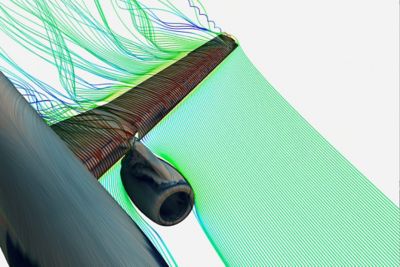
Voltage contours for the two-electrode model with a 10mm crust

Current flux contours for the two-electrode model with a 10mm crust

Cut-away view of voltage contours for the multiple electrode model
The thermal analysis models specialized
heaters to simulate the effects
of decay heat in the molten corium,
and direct electrical heating (DEH) of
the corium is one way to meet the heat
requirements. In some test configurations,
the outside of the vessel wall
is cooled, and this leads to the formation
of a solidified corium crust adjacent to
the wall on the inside. Since the crust
acts as an electrical insulator, it prevents
Joule heating from taking place in the
vessel wall.
Heat transfer calculations in FIDAP
simulated DEH in a crucible of molten
corium using a computed electric field
as the heat source. The thermal and
electrical conductivities in the corium
are strong functions of temperature. Two
sets of 3D steady-state simulations were
performed along with one set of 2D
transient simulations. In the steady-state
runs, crusts of varying thicknesses were
included in the models. In the transient
runs, a crust was allowed to form using
the phase change capability in FIDAP.
The corium composition used in the
simulations was similar to the material
that relocated during the Three Mile
Island Unit 2 (TMI-2) accident in 1979.
The results showed that DEH of the
corium is an appropriate method to
use, provided that sufficient cooling exists
on the outside of the vessel. The simulations
also illustrated how the thickness
of the crust that results from external
cooling impacts the voltage and
current requirements. Bounding cases
were performed to determine the specifications
for a power supply that can
deliver the maximum voltage and maximum
current needed for the range of
conditions studied. The maximum current
that would be needed to generate
the required heating power was
found to occur when there is no crust,
and the corium temperature is around
3300K. The maximum voltage that
would be needed was found to be for
the lowest corium temperature and the
thickest crust, because of the increased
total resistance between the electrodes.
A 24-electrode model was found to be
superior to a 2-electrode model for producing
uniform heating. The multiple
electrode configuration would be less
expensive to build, because it requires
less current per electrode to produce
the same heating power, and therefore
requires smaller leads. The multiple
electrode simulations indicated that
three-phase power would offer no advantage
over a single-phase source.
Transient calculations were performed
to gain insights about what type of
power supply controller would be needed
to regulate the voltage to the heaters
for these tests. These calculations also
showed that if the vessel is under-cooled
while a constant voltage is applied, the
corium will eventually melt the vessel
wall. The FIDAP simulations determined
that to deliver a constant power of 55kW,
the voltage requirements are from +/-
1.2V to +/-10.78V depending on the
temperature of the corium and the crust
thickness. The corresponding current
range is from 2,551 to 22,900
Amperes.
|
|
|