



| |
By Geoffrey W. Cowles, Nicola Parolini, Modeling and Scientific Computing,
Ecole Polytechnique Fédérale de Lausanne, Switzerland; and Mark L. Sawley,
Granulair Technologies, Lausanne, Switzerland
Under the direction of Grant Simmer, the coordinator of the Alinghi
Design Team, two new boats have been designed and constructed for the
2003 Americas Cup race. This has been the result of a Team project,
involving all twelve of Alinghis designers, researchers from the
EPFL, and many Alinghi sailors.
Americas Cup yacht racing has, over the past 150 years, proved
to be a formidable testing ground. To challenge the best in this field,
a high standard of technological knowledge and innovation has become essential.
The engagement of the Ecole Polytechnique Fédérale de Lausanne
(EPFL) as Official Scientific Advisor to the Alinghi Challenge for the
2003 Americas Cup, has provided the EPFL with the opportunity to
continue its efforts in the numerical flow simulation of high-performance
racing yachts.
Resolving the mathematical equations governing the flow around an International
Americas Cup Class (IACC) boat is complicated by the complex physical
modeling required to account for hydrodynamic and aerodynamic flows, wave
generation on the water surface, and fluid-structure interaction with
the mast and sails. While potential flow methods are extensively
used, to obtain a competitive edge in an application area where small
performance differences can result in significant gains, it is important
to account for more complex flow behavior. Solving the Reynolds-Averaged
Navier-Stokes (RANS) equations provides detailed insights that
when combined with standard numerical methods, experimental testing, empirical
techniques and experience can suggest ways to improve boat performance.

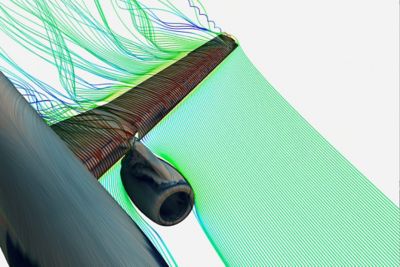
Surface pressure and pathlines around the appendages
At the EPFL, FLUENT is used to compute both hydrodynamic and aerodynamic
flows around the boat. Mesh generation is generally undertaken using GAMBIT.
In close collaboration with the Alinghi Design Team, detailed numerical
studies are being performed in three principle areas: hydrodynamic flow
around the boat appendages, aerodynamic flow around the mast and sails,
and the generation of waves on the water surface. By calculating the pathlines,
surface pressure, and global forces on the boat, the basic physical phenomena
can be qualitatively and quantitatively examined.
To have a realistic hope of winning the Americas
Cup, we need to excel in many areas. Thats the reason the partnership
with the Ecole Polytechnique Fédérale de Lausanne (EPFL)
is so important to us. The EPFLs academic expertise helps us to
validate ideas quickly in broad fields such as material resistance, structural
integrity, aero- and hydrodynamics, etc. In particular, the results of
computational fluid dynamics simulations have provided Alinghi with essential
information necessary for optimal design choice.
-Grant Simmer, Coordinator of the Alinghi Design Team
Numerical flow simulations are being conducted for different bulbkeel-
winglet configurations in order to determine the shape with the least
drag (within the applied constraints of weight, structural strength, and
lift). Such a study performed for a variety of sailing conditions requires
not only numerous detailed simulations but also a significant effort in
analyzing the results.

Waves generated on the water surface by a Wigley hull

A birds-eye view of two sailboats on the water, sailing downwind;
pathlines indicate the interaction between the boats
The presence of strong viscous effects, such as flow separation on the
mainsail behind the mast for upwind sailing, and around the spinnaker
and mainsail for downwind sailing, require the use of RANS simulations.
For our studies, the flying shape of the sails is considered and aero-elasticity
effects are neglected. The flow around the sails and exposed hull on an
IACC boat is calculated, as well as the interaction between two identical
boats.
A boat hull is subject to two main resistance components: wave drag and
viscous drag. While the viscous component can be accurately approximated
by empirical formulae, wave resistance is more difficult to predict. The
blunt bow of an IACC boat generates breaking waves that are difficult
to treat using the moving-mesh surface-tracking technique commonly used
in marine simulation software. The volume of fluid (VOF) approach used
by FLUENT avoids this problem. Initial calculations of the flow around
a 2.5m long simplified hull form (the Wigley hull) have provided wave
resistance values in good agreement with towing tank data. Its application
to more complex IACC shapes is currently being investigated.
It is interesting to compare the computational resources currently used
with those employed at the EPFL during the last Americas Cup challenge
more than three years ago. While the computational time per simulation
has remained unchanged, the maximum problem size has increased from two
million to over five million cells. With the recent availability of relatively
low-cost desktop workstations that are able to perform sizeable flow simulations,
the largest problem sizes considered in the previous challenge can now
be computed comfortably on a desktop PC. Nevertheless, highend parallel
systems are still being used to explore more complex physical phenomena
with increasing detail and precision to provide the elusive competitive
edge required to claim sailings greatest prize.

Comparison of computed (blue line) and experimental (red circles) values
of the waterline on the surface of a 2.5m Wigley hull
The Ongoing Success of the EPFL
Alain Drotz and Marie-Christine Sawley, EPFL, Lausanne, Switzerland
Surrounded by mountains on the shore of Lake Geneva, the Ecole Polytechnique
Fédérale de Lausanne (EPFL) campus encompasses an area of
136 acres. The EPFL was founded as an engineering school 150 years ago,
and became a Federal University in 1969. Its history is marked by extraordinary
periods dominated by growth and new development. Today, it is one of the
two leading scientific and technological universities in Switzerland,
offering degrees in fields such as fundamental sciences, engineering science,
communication and computer science, environmental sciences, civil engineering,
and architecture. For over 10 years, teaching and research at the EPFL
campus have been fostering innovative business creation and technology
transfer. There were 42 patent applications in 2001, and a Science Park
has been constructed on campus that shelters approximately 40 start-up
companies. In 2001, the total value of research contracts with industrial
partners reached 33 million Swiss Francs. The EPFL has a long experience
in numerical simulation for scientific and engineering applications, in
areas ranging from turbines to plasma physics and fusion, atomistic and
molecular simulations to atmospheric pollution modeling, and automotive
simulations to aeronautics. The Institute has also been associated with
the technical adventures of several Swiss citizens, such as the space
mission of astronaut Claude Nicolier and the first non-stop, around-the-world
balloon trip by Bertrand Piccard. Since last year, the EPFL has been the
Official Scientific Advisor to the Alinghi Challenge for the 2003 Americas
Cup.
|
|
|