




fluent.com home page


The Dynamic Mesh Model


By Jerry Lim,Fluent Inc.

Introduced as a beta feature in FLUENT 6.0, the dynamic mesh model, part of the moving and deforming mesh capability, extends the capacity of the FLUENT solver to handle problems that involve unsteady moving geometry. After successfully completing several industrial strength test cases, and featuring several enhancements, the dynamic mesh model is being formally released to all users in FLUENT 6.1. In addition to significant robustness improvements, the model will be fully parallelized.

View Larger Image
Valve motion shown in two steps above; below, the first step is shown in cyan (light blue) the second is overlayed in magenta, and grey denotes no change to the mesh between the steps
View Larger Image

In order to accommodate a wide range of motion types, FLUENT 6 offers three modes of mesh deformation: dynamic layering, spring smoothing, and local remeshing. The first two approaches are similar to mesh motion schemes that have been widely used for many years. Dynamic layering is useful for linear motion.

Layers are added and deleted to accommodate the specified boundary motion. The term “dynamic” means that the process is handled internally by the FLUENT solver, based only on a specified ideal cell height, and factors that govern when a cell should split and when two should coalesce. These parameters define upper and lower cell height limits. When the cell height limits are exceeded, FLUENT automatically detects this condition, and splits or coalesces the layer as needed. Because cells are added and deleted, neighbor connectivity changes are made as well. This approach may be utilized for quadrilateral (2D volume cells and 3D boundary faces), prismatic, and hexahedral element types.

The spring smoothing method is useful for relatively small deformations. The assumption in FLUENT is that the mesh nodes are connected like a network of springs. By performing a force balance on each of the “spring elements”, an equilibrium balance is sought which provides a smooth (minimum energy) mesh. If two elements (nodes) are too close, the spring force will repel the nodes away from each other. Since each nodal position depends on its neighbor nodes, and the neighbor nodal positions are dependent on their own neighbor nodes, spring smoothing is accomplished through an iterative process, like that used by other elliptic mesh generators. The spring smoothing process does not result in any connectivity changes since all node/cell relationships are preserved. Used as a stand-alone scheme, spring smoothing is limited, since excessive deformation will result in highly skewed cells. The spring smoothing algorithm may be used for triangular (2D volume cells, 3D boundary faces) and tetrahedral elements.

View Larger Image
Pressure contours on a 3D valve

The third approach, local remeshing, represents a departure from traditional mesh motion schemes. In this approach, the cell size and quality (skewness) limits are prescribed. As mesh motion occurs, cells will eventually exceed the prescribed limits. FLUENT detects these cells and marks them for remeshing. In addition to marking the offending cells, several neighbor cells are also marked. This collection of cells represents a subdomain, which is automatically remeshed using the TGrid algorithm that is now built into FLUENT. After remeshing, the CFD solution is interpolated onto the new cells. Thus, rather than generate a completely new mesh for the entire volume, remeshing and interpolation works on a local basis. As with dynamic layering, local remeshing implies connectivity changes. Typically (but not necessarily), it is used in conjunction with spring smoothing. The local remeshing algorithm may be used for triangular (2D volume cells, 3D boundary faces) and tetrahedral elements.

View Larger Image
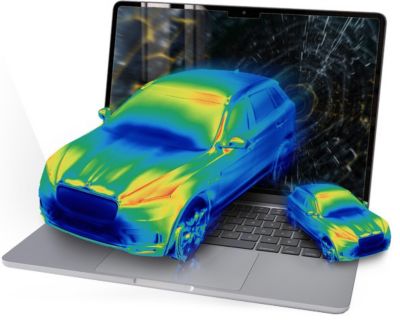
The mesh around two Ahmed bodies deforms as one (grey) overtakes another (red)

A dynamic calculation requires an initial mesh and description of the boundary motion. A model with several independently moving parts can be treated using different zones to represent the different parts. Independent motions for these parts can be specified, and the regions surrounding them will be remeshed using whichever technique is appropriate at the time. The flexibility of the model makes it well suited to address a number of different application areas, as described in the articles that follow.

View Larger Image
Contours of exhaust gas mass fraction are used to illustrate the launch of a rocket, solved using the dynamic mesh model in FLUENT

FluentNEWS Next Article